
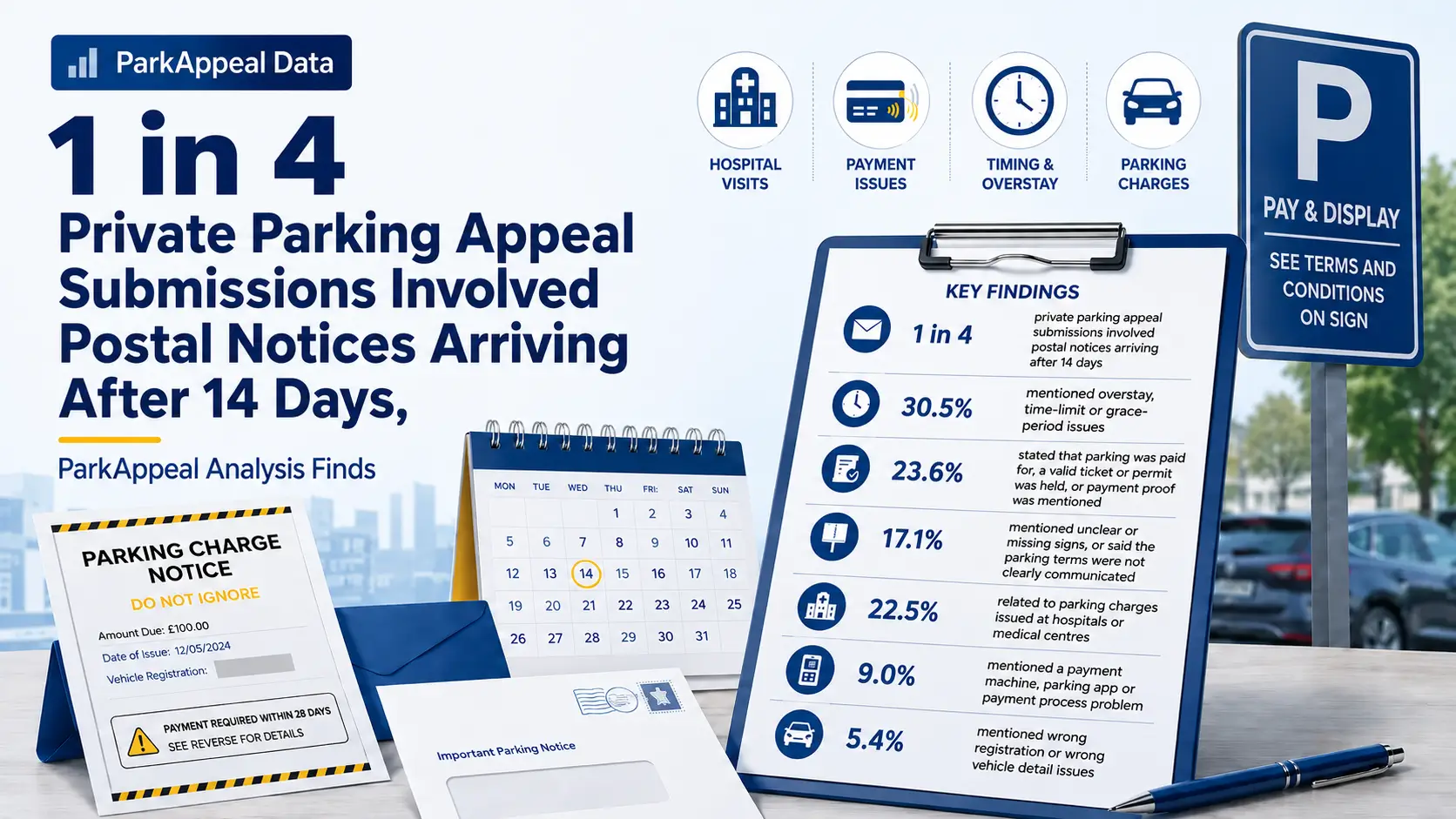
ParkAppeal analysed 849 anonymised private parking appeal form submissions to identify the most common issues raised by motorists preparing to challenge charges issued by private parking operators.
A ParkAppeal analysis of 849 anonymised private parking appeal form submissions found that 1 in 4 involved a reported first postal notice arriving more than 14 days after the parking event.
The analysis also found that drivers preparing private parking appeals commonly raised issues involving overstay and grace periods, payment attempts, unclear signage, hospital parking, Blue Badge or accessibility-related circumstances, and parking app or machine problems.
Last updated: 17 June 2026
Media summary
ParkAppeal analysed 849 anonymised private parking appeal form submissions from drivers in England and Wales. The analysis found that 212 submissions — equal to 25.0% of the dataset — involved a reported first postal notice arriving more than 14 days after the parking event.
This timing can be important because, under Schedule 4 of the Protection of Freedoms Act 2012, a postal Notice to Keeper must usually be given within 14 days if a private parking operator wants to rely on keeper liability where no windscreen notice was issued.
Across the analysed date-based submissions, the average postal notice delay was 13.6 days, excluding same-day entries and invalid or extreme entries.
Other common issues raised by drivers included overstay and grace-period disputes, payment or permit problems, hospital and medical centre parking charges, unclear signage, Blue Badge or accessibility-related circumstances, and problems with parking apps, machines or vehicle registration systems.
Dataset note: These findings are based on 849 anonymised ParkAppeal appeal-form submissions from drivers in England and Wales. They show common issues raised by people preparing private parking appeals, rather than a representative sample of all UK parking charges.
Key findings from the analysed submissions
Comment from ParkAppeal
A ParkAppeal spokesperson said: “These figures show that many drivers preparing private parking appeals are raising practical issues, not simply refusing to pay. We saw repeated themes around late postal notices, unclear signs, payment attempts, hospital parking, Blue Badge-related circumstances, and problems with apps or machines.”
“The 14-day postal notice issue stood out because timing can be important in some private parking cases, especially where keeper liability may be relevant. Drivers may want to check the dates carefully, keep evidence where possible, and make sure any appeal focuses on the facts of their case.”
Overstay and time-limit issues were the most common theme
The data found that 30.5% of completed appeal form submissions analysed mentioned overstay, time-limit or grace-period issues.
Separately, when users selected a single ticket reason, overstaying allowed time was the most common listed parking charge reason, appearing in 25.8% of analysed submissions.
Payment was another major issue
23.6% of completed appeal form submissions stated that parking was paid for, a valid ticket or permit was held, or payment proof was mentioned.
Payment technology also featured in the data, with 9.0% of submissions mentioning a payment machine, parking app or payment process problem.
In the evidence section, 16.7% of submissions selected proof of payment attempt, such as a bank statement or parking app record, while 13.4% selected a receipt from the shop or business visited as evidence.
Hospitals and medical centres were the most common recorded location type
Hospitals and medical centres were the most common recorded location type, accounting for 22.5% of completed appeal form submissions analysed.
Supermarkets and retail parks were also heavily represented. Combined, more than one in three completed appeal form submissions analysed related to supermarkets, retail parks or shopping centres.
This was based on 317 submissions out of 849, combining supermarket submissions and retail park or shopping centre submissions. Each form submission could only include one location type.
Blue Badge and accessibility-related issues appeared frequently
21.1% of completed appeal form submissions analysed selected disability or Blue Badge considerations as an appeal ground.
Separately, 21.2% selected a copy of a Blue Badge as evidence.
Blue Badge and accessibility data note
These figures reflect selected appeal grounds and evidence types within anonymised form submissions. They do not identify individual motorists or confirm disability status.
Some users had no evidence available
16.4% of completed appeal form submissions analysed said they did not currently have any evidence.
This suggests that a noticeable number of people completing the appeal form were preparing an appeal without supporting documents, photos, receipts or other evidence available at that point.
Vehicle registration and check-in problems also appeared
9.0% of completed appeal form submissions analysed listed “vehicle not registered on site” as the parking charge reason.
Separately, 5.4% of submissions mentioned wrong registration or wrong vehicle detail issues.
Raw breakdown of analysed form submissions
The tables below show the raw breakdown of selected fields from the 849 analysed submissions.
Ticket reason selected
Users could select one parking charge reason per form submission.
| Ticket reason | Count | % of analysed submissions |
|---|---|---|
| Overstayed allowed time | 219 | 25.8% |
| Other / not sure | 198 | 23.3% |
| No payment or payment expired | 130 | 15.3% |
| Vehicle not registered on site | 76 | 9.0% |
| Parked in a disabled bay | 52 | 6.1% |
| Unknown / blank | 41 | 4.8% |
| No ticket displayed | 29 | 3.4% |
| Parked in a permit / resident bay | 27 | 3.2% |
| Wrong vehicle details entered | 23 | 2.7% |
| No permit / badge displayed | 22 | 2.6% |
| Not parked within bay markings | 11 | 1.3% |
| Stopped where not allowed | 8 | 0.9% |
| Parked on yellow lines / restricted area | 4 | 0.5% |
| Parked in a Parent & Child bay | 3 | 0.4% |
| Parked on pavement or grass verge | 3 | 0.4% |
| Parked in a loading bay | 2 | 0.2% |
| Parked in a suspended bay | 1 | 0.1% |
Recorded location type
Users could select one location type per form submission.
| Location type | Count | % of analysed submissions |
|---|---|---|
| Hospital / Medical Centre | 191 | 22.5% |
| Supermarket | 177 | 20.8% |
| Retail Park / Shopping Centre | 140 | 16.5% |
| Other | 123 | 14.5% |
| Hotel | 62 | 7.3% |
| Residential Area | 36 | 4.2% |
| Restaurant / Fast Food | 28 | 3.3% |
| Gym / Leisure Centre | 27 | 3.2% |
| Workplace / Business Park | 19 | 2.2% |
| University / College | 15 | 1.8% |
| Motorway Service Area | 15 | 1.8% |
| Airport / Drop-off Zone | 10 | 1.2% |
| Train Station / Transport Hub | 6 | 0.7% |
Appeal grounds selected
Users could select up to five appeal grounds per form submission, so these percentages do not add up to 100%. “Notice arrived after the 14-day limit” shows 26.6% here, compared with the verified date-based figure of 25.0% above. The verified figure was calculated from notice dates showing a gap of 15 days or more, while this table reflects appeal grounds selected or triggered within the form.
| Appeal ground | Count | % of analysed submissions |
|---|---|---|
| Notice arrived after the 14-day limit | 226 | 26.6% |
| Disability or Blue Badge considerations apply | 179 | 21.1% |
| Parking was paid for or a valid ticket was displayed | 173 | 20.4% |
| Parking signs were unclear or missing | 102 | 12.0% |
| Errors in the notice or handling of the charge | 101 | 11.9% |
| Frustration of Contract (breakdown, emergency or medical) | 83 | 9.8% |
| Payment machine or parking app was not working | 70 | 8.2% |
| No grace period was given | 64 | 7.5% |
| No clear contract was formed | 61 | 7.2% |
| Wrong registration was entered | 37 | 4.4% |
| Notice contains errors or missing information | 35 | 4.1% |
| You are not legally responsible for this charge | 28 | 3.3% |
| I was not the driver at the time | 26 | 3.1% |
| The vehicle was a hire, lease or company car | 11 | 1.3% |
| No proof of landowner permission | 7 | 0.8% |
| Charge exceeds Code of Practice limits | 4 | 0.5% |
| Vehicle was taken without permission | 3 | 0.4% |
Evidence selected
Users could select multiple evidence types. If “I do not currently have any evidence” was selected, no other evidence option could be selected.
| Evidence type | Count | % of analysed submissions |
|---|---|---|
| Other evidence | 188 | 22.1% |
| Copy of a Blue Badge | 180 | 21.2% |
| Proof of payment attempt (bank statement, payment app, etc.) | 142 | 16.7% |
| I do not currently have any evidence | 139 | 16.4% |
| Receipt from the shop or business visited | 114 | 13.4% |
| Proof of time at the location (e.g. timestamps, app logs, receipts) | 72 | 8.5% |
| Medical or emergency evidence | 60 | 7.1% |
| Photos of parking signs at the location | 44 | 5.2% |
| Permit or authorisation to park (if applicable) | 29 | 3.4% |
| Photo of the ticket placed on the vehicle | 26 | 3.1% |
| Evidence of faulty machines or payment issues | 16 | 1.9% |
What this data suggests
The findings suggest that many people preparing private parking appeals are not simply disputing charges because they do not want to pay. Common themes include late postal notices, unclear signs, payment attempts, Blue Badge or accessibility-related circumstances, hospital parking, and issues with apps, machines or vehicle registration systems.
The high number of overstay and time-limit issues also highlights how important timing can be in private parking cases, particularly where grace periods, entry and exit times, or delayed departures may be relevant.
Anonymised issue themes seen in the submissions
The analysed submissions also showed the types of real-world situations drivers described when preparing appeals. The examples below are anonymised themes based on the issues raised in form submissions, not individual case outcomes.
- Hospital or medical centre visits: some submissions related to charges issued at hospitals or medical centres, with some also raising medical, emergency or accessibility-related circumstances.
- Paid but still received a charge: some submissions said payment had been made, a valid ticket or permit was held, or proof of payment was available.
- Blue Badge or accessibility-related circumstances: some motorists selected disability or Blue Badge considerations as part of their appeal grounds or evidence.
- Machine, app or registration problems: some submissions mentioned payment machine issues, parking app problems, failed payment attempts, or wrong vehicle registration details.
Common evidence that appeared in the data
- Blue Badge evidence
- Proof of payment attempts
- Receipts from shops or businesses visited
- Proof of time at the location
- Medical or emergency evidence
- Photos of parking signs
- Permit or authorisation evidence
Evidence should always be relevant to the reason you are appealing. Unrelated documents can make an appeal less focused.
For journalists and media enquiries
This report can be referenced as a ParkAppeal analysis of 849 anonymised private parking appeal form submissions from England and Wales.
- Sample size: 849 analysed submissions
- Scope: private parking operator charges only
- Geography: England and Wales
- Main finding: 212 submissions, or 25.0% of the dataset, involved a reported first postal notice arriving more than 14 days after the parking event
- Dataset note: this is ParkAppeal user-submission data showing common issues raised by people preparing private parking appeals, rather than a representative sample of all UK parking charges
For comment or media enquiries, please contact ParkAppeal through the ParkAppeal contact page.
Create an AI-Powered Private Parking Appeal Letter
Answer a few simple questions about your parking charge, what happened and any evidence you have. ParkAppeal then generates a structured, personalised appeal letter in minutes, ready for you to review and submit yourself.
Create Appeal Letter →Related appeal letter guides for specific parking companies
This report looks at common issues raised across anonymised ParkAppeal submissions. If you are preparing an appeal for a charge from a specific private parking company, you may also find these appeal letter guides useful:
- ParkingEye appeal letter guide
- Euro Car Parks appeal letter guide
- UKPC appeal letter guide
- APCOA appeal letter guide
- Smart Parking appeal letter guide
- Horizon Parking appeal letter guide
You can also view the full list of private parking operator appeal guides.
Disclaimer
ParkAppeal is not a law firm and does not provide legal advice. Our software generates appeal letters for you to review and submit yourself. Whether an appeal is accepted depends on the facts, evidence, the parking company, the appeal body and the process used.
The figures in this article are based on anonymised completed appeal form submissions from ParkAppeal users. They show common issues raised by those users and should not be treated as a representative sample of all UK parking charges. References to postal notice timing are based on information provided in the analysed submissions.